
AHA Changes Guidelines for Emergency Treatment of Choking Adults and Children: Heimlich Maneuver No longer First Line
We still don’t have the randomized trial of the best approach that I demanded back in 2018, but at least the current guidance relegates the potentially dangerous Heimlich maneuver to the second level

If you are interested in saving the life of someone who collapses in your vicinity, you really should take a 2-hour course on bystander basic life support:-

I first wrote about these 3 letter words in 2016, and that is probably when I started bugging my wife to take a basic life support (BLS ) course.
She took the course last week and informed me that a significant change had occurred in the AHA-recommended approach to a choking victim: the abdominal thrust, aka the Heimlich maneuver, is no longer recommended as the first-line therapy.
Indeed, in October 2025, the AHA released its first major CPR/ECC guideline update since 2020, and made a change to recommendations for the bystander approach to a choking adult or child, first issued in 2010 and left unchanged since then1.
The new 2025 guidelines now recommend alternating 5 back blows followed by 5 abdominal thrusts — repeating until the object is expelled or the person becomes unresponsive.
For infants <1 year specifically, the guidelines now call for alternating 5 back blows with 5 chest thrusts (not abdominal thrusts), because abdominal thrusts carry a real risk of injuring an infant’s organs.
AHA says it was changed because “studies of adults with FBAO showed that back blows were associated with improved rates of FBAO relief and fewer injuries compared with abdominal thrusts” and cites a 2024 observational study.
I was happy to see this change as the evidence supporting the Heimlich has been suspect from the very beginning, when Heimlich first wrote about it in 1974, something I pointed out in great (perhaps excruciating) detail in 2018 in a post entitled “A Call To Reconsider The Heimlich Experiment: Let’s Scientifically Determine The Best Approach To Choking Victims,“
Back then I had become fascinated in the origins of the emergency approach to choking, which were developed2 and widely promoted by Dr. Henry Heimlich, the so-called Heimlich Maneuver. Aided by research done by his son, Peter Heimlich, and interviews with Dr. Chuck Guildner, I delved deeply into the fascinating story and discovered that there was little evidence to recommend it as the initial approach to someone choking on a foreign body (aka foreign body airway obstruction or FBAO).
I wrote about this in two articles on my blog. I have republished the first part of the first article, below, which presents the fascinating history of Heimlich’s development and promotion of his eponymous maneuver.
I’ll republish the second half of that article and my original post focused on the harms of the Heimlich maneuver in subsequent Substack articles.
What should you do if you encounter someone choking on food?
If you ask someone on an American street, the likely answer will be to “perform a Heimlich maneuver.”
This is understandable because we frequently hear of celebrities performing or having performed on them a Heimlich maneuver and saving or being saved from choking to death. In addition, we have descriptions of individuals relating their own stories of lives saved.
For example, in May of 2016, 96-year-old Dr. Henry Heimlich, widely credited as the inventor of the eponymous abdominal thrust procedure, made headlines around the world when he reportedly performed it on a fellow retirement home resident in Cincinnati.
Surprisingly, despite the widespread belief that the Heimlich maneuver is the scientifically-affirmed treatment of choice for choking victims, there is only anecdotal evidence for its effectiveness as well as its dangers and there is no scientific consensus on the best approach to a person who is choking or has foreign body airway obstruction (FBAO).
The Origins of The Heimlich maneuver
In 1972, Heimlich wrote in his autobiography “Heimlich’s Maneuvers“,
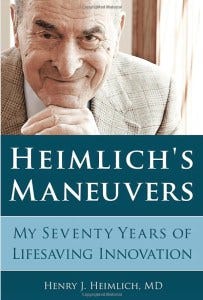
that he came across a NY Times article which revealed that the sixth leading cause of accidental deaths in the US was choking on a foreign body, usually food ,and that 3900 individuals were dying from foreign body airway obstruction (FBAO) a year.
The typical scenario for these deaths was first described in a 1963 JAMA report on 9 patients who suddenly collapsed at a dinner table and were subsequently pronounced dead on arrival to the emergency room.
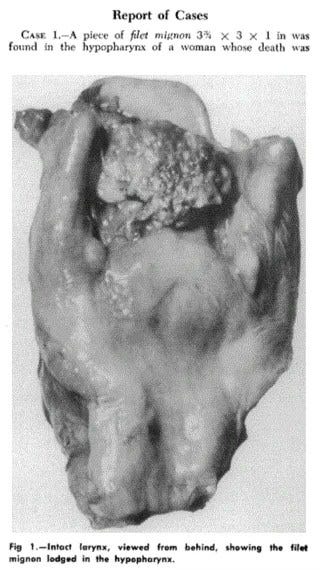
Death had been attributed to coronary artery disease but at autopsy these victims were found to have food obstructing their airways (4 by steak, 2 by beef, one by ham and one by kippered herring).
The author termed these sudden deaths in restaurants “The Cafe’ Coronary.”
In 1972 there was no consensus on how to treat victims of the Cafe’ Coronary and Heimlich noted that the three options were
Inserting a large-caliber hypodermic needle into the trachea or performing a tracheotomy
Utilizing an instrument designed to remove the object from the throat
Slapping choking victims on the back.
Noting the risks of option one, the impracticality of option two and the lack of scientific evidence to support option 3, Heimlich pondered a better approach, one that would utilize the residual air in the victim’s lungs to forcefully expel the lethal food bolus “like the cork from a Champagne bottle.”
Pop Goes The Cafe’ Coronary
Heimlich first described his namesake maneuver in an article in
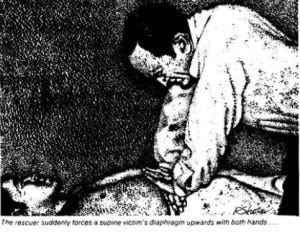
Emergency Medicine in June of 1974 entitled “Pop Goes The Cafe Coronary.”
Standing behind the victim the rescuer puts both arms around him just above the belt line, allowing head, arms and upper torso to hang forward. Then, grasping his own right wrist with his left hand, the rescuer rapidly and strongly presses into the victim’ abdomen, forcing the diaphragm upward, compressing the lungs and expelling the obstructing bolus
Heimlich states in the 1974 article that the procedure was adapted from “experimental work “with four 38-pound beagles.
Although admitting that these results might not be duplicated in humans, he indicates that “there is certainly no risk in recommending that the procedure be tried in actual cafe’ coronary emergencies.”
“then, as experiences are reported, the method can be evaluated.”
Shockingly, Heimlich, in this article (subsequently picked up and promoted by the lay press) proposed to all Americans that they begin an experiment on helpless choking victims to see if his newly developed idea was of any benefit.
He requests in the last lines of this monumental communication that Americans help him gather information from the experiment.
“Should you use, or learn of anyone else using, the Heimlich method by the way, please report the results either to EM or me.”
Flimsy Experimental Basis For Heimlich
Four 38-pound beagles-The experimental work supporting an unsupervised, unregulated national experiment on choking victims!
Below is the sum total of the description Heimlich provides for his experiments:
After being given an intravenous anesthetic, each dog was “strangled” with a size 32 cuffed endotracheal tube inserted into the larynx. After the cuff was distended to create total obstruction of the trachea, the animal went into immediate respiratory distress as evidenced by spasmodic, paradoxical respiratory movements of the chest and diaphragm. At this point, with a sudden thrust. I pressed the palm of my hand deeply and firmly into the abdomen of the animal a short distance below the rib cage, thereby pushing upward on the diaphragm. The endotracheal tube popped out of the trachea and, after several labored respirations, the animal began to breathe normally. This procedure was even more effective when the other hand maintained constant pressure on the lower abdomen directing almost all the pressure toward the diaphragm.
We repeated the experiment more than 20 times on each animal with the same excellent results When a bolus of raw hamburger was substituted for the endotracheal tube, it, too, was ejected by the same procedure, always after one or two compressions.
This “experimental work” seems to have been sloppily done and would not have passed muster through a legitimate current day peer-reviewed scientific journal. It seems more like the observations of an 18th century scientist than a 20th century one.
Here are a few of the red flags I see that suggest either these experiments weren’t really done or that they need to be repeated with better documentation or by an investigator who is unbiased as to the outcome.
The beagles are all exactly the same size
There are no measurements recorded. Of any kind.
Important data was not recorded: What anesthetic was utilized? What was the position of the animals? How long between experiments?. How many “more than 20 times” were the animals choked.? How big was the hamburger bolus?
Flimsy Experimental Work Embellished And Republished
